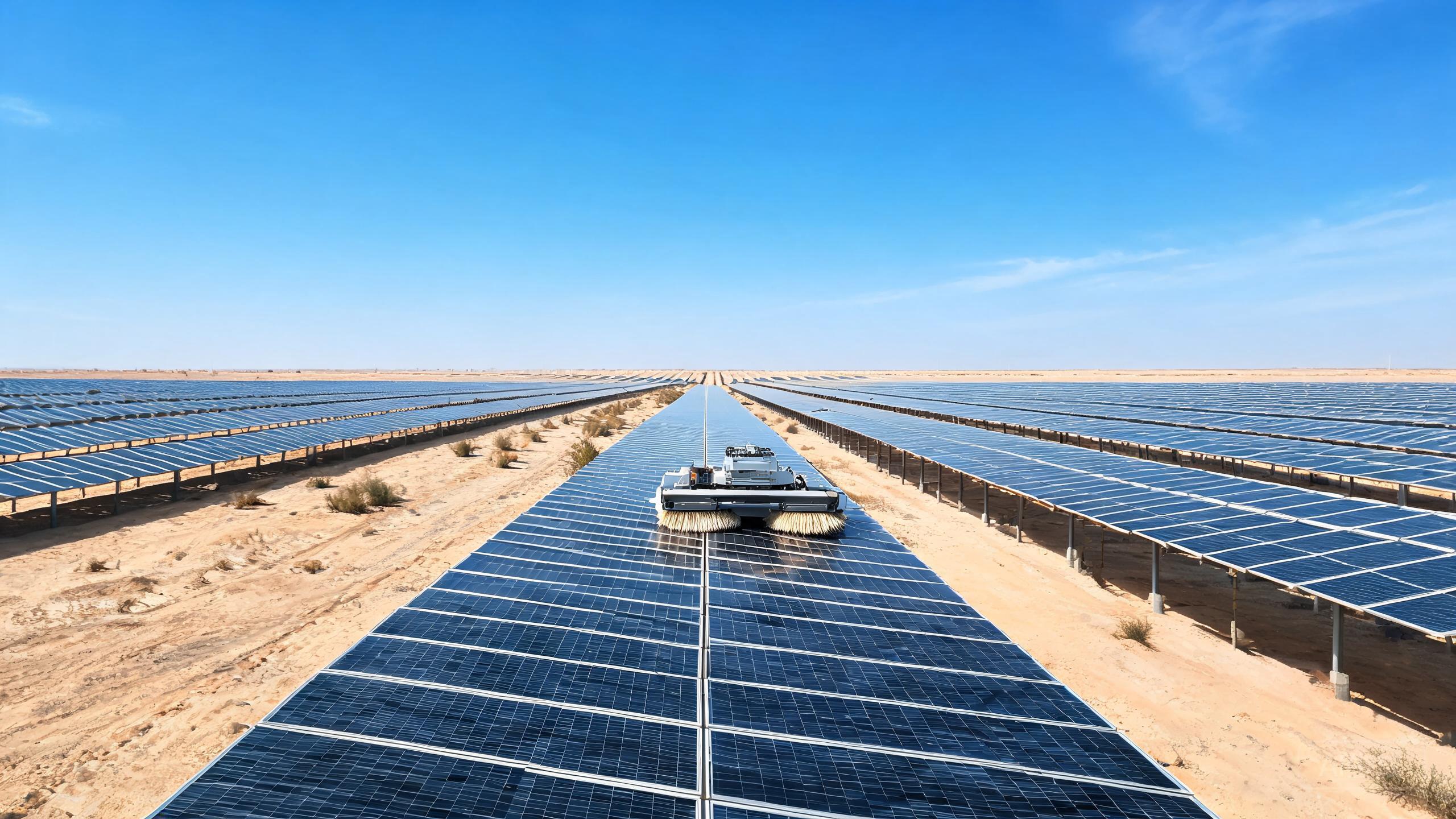
Most coverage of the X8 Robotics X8 Plus argues the case for tracks over wheels. This deep dive skips that debate and instead reads the machine as an engineering document: what the tracked drive actually implies for a utility scale PV cleaning robot, how a brush-only head shapes maintenance intervals, and why a contact-only price tag complicates any solar panel cleaning robot cost comparison. If you are weighing a waterless solar panel cleaner for flat, dusty ground-mounted sites, the specifications below are what you need to interrogate before requesting a quote.
Drive System: What 'Tracked' Actually Changes
The single defining specification is the drive: tracked, not wheeled. On paper this is one word; in the field it changes the contact patch. Tracks spread load across a longer footprint, which is the mechanical reason a machine can keep moving over the loose dust, grit and minor surface irregularities common on ground-mounted plants. The trade-off is equally mechanical: tracks add moving parts and demand more attention to tension and debris build-up than simple wheels. For buyers shortlisting the best solar panel cleaning robot 2026 for a large flat site, the question is not whether tracks are superior in the abstract, but whether your array rows are uniform enough that a tracked chassis is an asset rather than overkill.
Cleaning Head: Brush-Only and the Waterless Question
The cleaning specification is deliberately narrow: brush. There is no stated water system, which places the X8 Plus firmly in the waterless solar panel cleaner category. That matters for site logistics — no tanks, no water runs, no runoff management — and it matters for the dry vs wet solar panel cleaning debate. Brush-only dry cleaning is effective against accumulated dust, the dominant soiling type on many ground-mounted plants, but it is a different tool from wet washing when the soiling is cemented, oily or biological. The practical takeaway from the spec sheet is that this machine is optimized for one soiling profile. Buyers asking does solar panel cleaning improve output should note that the answer depends heavily on matching the cleaning method to the soil type, not on the robot alone.
Terrain Envelope and Application Boundaries
Two specifications define the operating envelope: terrain rated rough and dusty, and application limited to ground-mounted plants. Read together, they describe a machine intended for flat or gently undulating utility-scale sites with unpaved access paths — not rooftop arrays, not steep or complex civil structures. That focus is a strength for a utility scale PV cleaning robot deployment where rows are long and consistent, and a limitation anywhere the array geometry changes frequently. The simple mechanical design listed among the pros reinforces the same story: fewer subsystems to fail, but also fewer capabilities to adapt. Buyers should map their site's row spacing and surface conditions against this envelope before treating the X8 Plus as a candidate.
Commercial Reality: Contact-Only Pricing and Market Presence
The specification sheet is silent on price, and the cons list confirms why: contact-only pricing. This is the single biggest obstacle to any solar panel cleaning robot cost analysis involving the X8 Plus. Without a published figure, buyers cannot benchmark it against alternatives on a per-watt or per-machine basis, and total cost of ownership — including track maintenance and brush replacement — stays opaque until a formal quote arrives. Combined with limited market presence, this positions the X8 Plus as a niche, evaluation-heavy purchase. That is not disqualifying for a large operator with time to run a pilot, but it does mean the machine should be shortlisted on site fit and support terms rather than on headline price.
Our verdict
Read as a specification document rather than a marketing pitch, the X8 Plus is coherent: tracked drive, brush cleaning, rough-and-dusty terrain, ground-mounted plants. Every element points at the same use case — flat, dusty, large-scale sites where a waterless solar panel cleaner makes logistical sense. The gaps are commercial rather than mechanical: no published pricing and thin market presence mean the machine earns its place through pilot data, not brochures. For operators who can test before committing, it is a defensible niche candidate; for those who need transparent solar panel cleaning robot cost figures up front, it will be a frustrating shortlist entry.