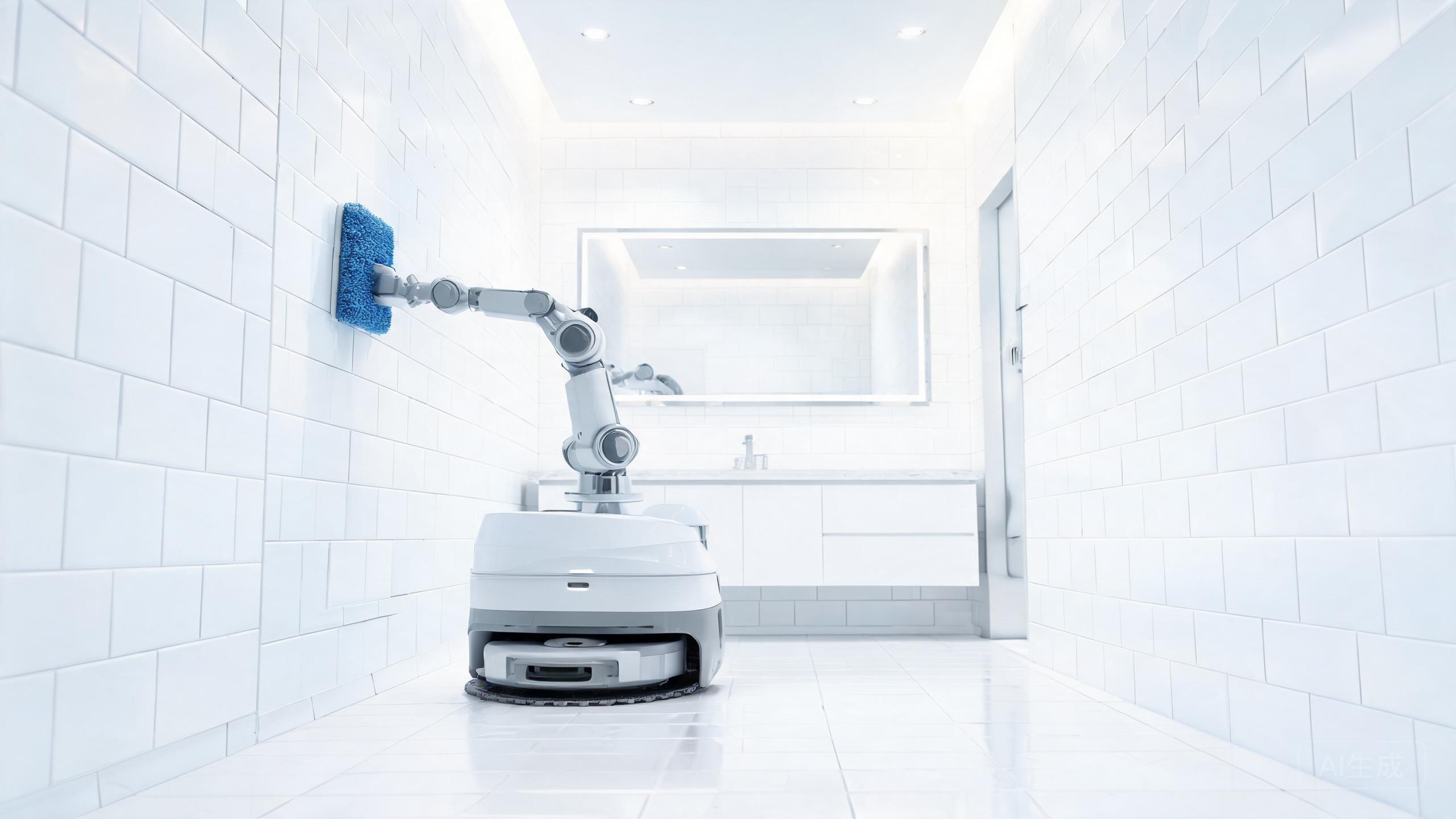
Most coverage of the Primech AI Hytron focuses on what it does — scrub, spray, disinfect. This deep dive goes the other way: we unpack the engineering stack that makes an autonomous toilet cleaning robot possible, from the NVIDIA Jetson compute module to the 6-DoF arm kinematics and the electrolyzed-water disinfection loop. If you care about how a robotic arm restroom cleaner actually thinks, moves and sanitizes, this is the layer-by-layer breakdown.
The Brain: NVIDIA Jetson as the Perception and Control Hub
The Hytron's central compute platform is an NVIDIA Jetson module, and that single choice shapes everything else about the robot. Jetson-class hardware is built for edge AI inference — meaning the Hytron can run vision models, sensor fusion and motion planning locally rather than shipping data to the cloud. For a restroom cleaning robot 2026 deployment, that matters for two reasons: latency and privacy. Latency, because a 6-DoF arm operating near porcelain, fixtures and users cannot wait on a round trip to a remote server. Privacy, because restrooms are camera-sensitive environments, and on-device processing keeps imagery inside the machine. The Jetson also gives the platform headroom — as disinfection and navigation models improve, the same silicon can absorb heavier workloads without a hardware redesign.
The Arm: Why 6 Degrees of Freedom Changes Restroom Coverage
A 6-DoF arm is the Hytron's defining mechanical feature, and it is worth understanding what those six axes actually buy you. Six degrees of freedom is the minimum needed to place an end effector at an arbitrary position and orientation in 3D space — the same kinematic threshold that lets industrial arms reach around obstacles rather than only toward them. In a restroom, that translates into reaching under rims, around cisterns, behind taps and into the awkward geometry that fixed brush heads simply cannot address. This is the core argument for a robotic arm restroom cleaner over a wheeled scrubber: the arm converts a flat cleaning path into a volumetric one. The trade-off, as our product data notes, is that the Hytron leans toward disinfection over aggressive scrubbing — the arm is optimized for precise application of electrolyzed water, not for grinding away baked-on residue.
The Chemistry: Electrolyzed Water and the >99% Efficacy Claim
The Hytron's disinfection subsystem uses electrolyzed water, and the product data cites a tested germ kill rate above 99%. Electrolyzed water is generated on demand by passing a brine solution through an electrolytic cell, producing a sanitizing agent that is effective against a broad microbial spectrum and then reverts to ordinary water over time. For commercial restroom cleaning automation, that on-demand generation is the operationally interesting part: no concentrated chemical drums to store, no dilution errors, no residue concerns on high-touch surfaces. The >99% figure is the headline number, but the deeper engineering story is repeatability — an autonomous toilet cleaning robot applies the same dose, in the same pattern, on every cycle, which is something manual cleaning struggles to guarantee across shifts.
Integration: What the Spec Sheet Says About Real Deployment
Read the four headline specs together — NVIDIA Jetson compute, 6-DoF arm, electrolyzed-water disinfection, >99% efficacy — and a clear architectural philosophy emerges. This is a perception-heavy, precision-oriented platform rather than a brute-force scrubber. That has direct implications for restroom robot cost and facility planning: you are paying for edge AI silicon and a six-axis manipulator, not for a larger tank or a bigger brush. It also explains why the Hytron is positioned as pre-commercial. A robotic arm restroom cleaner at this level of integration needs validation across real restroom variability — different fixture geometries, different soiling profiles, different traffic patterns — before the numbers on the spec sheet become the numbers in your facility.
Our verdict
The Primech AI Hytron is best understood as a stack, not a single product: Jetson compute for local intelligence, a 6-DoF arm for volumetric reach, and on-demand electrolyzed water for repeatable disinfection above 99% tested efficacy. Each layer solves a specific restroom problem, and together they define what a 2026 autonomous toilet cleaning robot can plausibly be. The open question is not the engineering — it is commercial validation, and that is where the next chapter of this platform will be written.