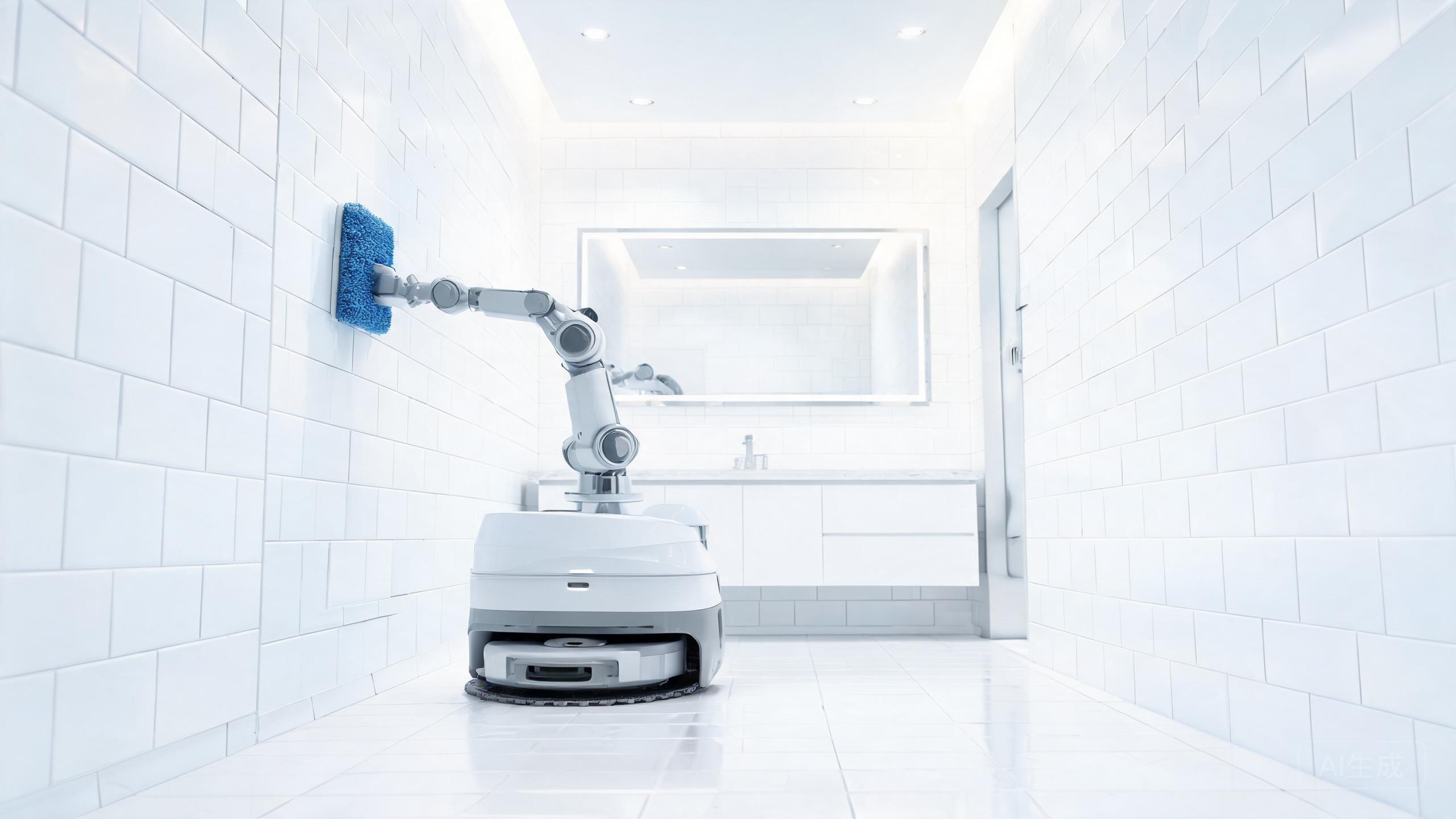
Most coverage of the HiveBotics Abluo M1 focuses on what it meant for the category. This deep dive does something different: it examines the machine as a piece of engineering. By walking through its published specifications one by one, we can understand exactly how a first-generation autonomous toilet cleaning robot was built, why its architecture matters for the restroom cleaning robot 2026 landscape, and what its hardware choices reveal about the limits and promise of early commercial restroom cleaning automation.
Generation and Type: What '1st Gen' and 'Autonomous' Actually Mean
The spec sheet lists the Abluo M1 under Generation: 1st gen and Type: Autonomous. Those two labels are the most important engineering facts about the machine. '1st gen' tells us this was HiveBotics' original platform, not an iteration. Every subsystem was a first attempt, which explains the narrow task scope noted in its cons. 'Autonomous' is the more consequential label. It means the unit was designed to operate without a human driver, which is the core value proposition of any autonomous toilet cleaning robot. For facility managers evaluating a bathroom cleaning robot review, autonomy is the dividing line between a remote-controlled tool and a true labor-saving device. The Abluo M1 crossed that line, and its spec sheet reflects a design optimized for unattended operation rather than teleoperation.
Task Scope: Why Toilet Cleaning Was the Beachhead
The Task field reads simply: Toilet cleaning. That narrow scope is deliberate. A first-generation platform needs a bounded, high-value problem to solve. Toilet cleaning is the most labor-intensive, least desirable task in any restroom, which makes it the ideal beachhead for a robotic arm restroom cleaner. By restricting the Abluo M1 to this single function, HiveBotics could focus its engineering resources on the mechanics of the task itself rather than on broad navigation and multi-surface handling. The trade-off is visible in the cons: narrower task scope. The machine does not sweep floors, restock paper, or wipe mirrors. It cleans toilets, autonomously, and that focus is precisely what allowed the concept to be proven.
Developer Profile: HiveBotics and the Systems Approach
The Developer field lists HiveBotics, and that single word carries weight. A first-generation product is a statement of intent from its maker. HiveBotics did not enter the market with a mature multi-task platform; it entered with a focused autonomous toilet cleaning robot and used it to validate the underlying technology. The verdict confirms this reading: the Abluo M1 proved the concept of unattended restroom upkeep and laid the groundwork for the Mark 2's broader coverage and refinement. From a specification standpoint, that means the M1 should be understood as a reference architecture. Its generation, task, and type values are the baseline against which the Mark 2's improvements are measured. For anyone tracking restroom robot cost trends, the M1's pricing logic also set expectations for what a single-task autonomous unit should cost versus a broader-coverage successor.
Reading the Pros and Cons as Engineering Signals
The pros list three items: proof of concept delivered, autonomous toilet cleaning, and lays groundwork for Mark 2. The cons list two: first-gen limitations and narrower task scope. Read together, these five data points describe a machine that succeeded at its primary mission and was never intended to do more. 'Proof of concept delivered' is the strongest signal. It means the autonomy stack, the cleaning mechanism, and the restroom-environment tolerance all worked well enough to justify a second generation. 'First-gen limitations' is the honest counterweight. Early platforms typically carry constraints in sensor coverage, cycle time, or error recovery that later revisions address. The Abluo M1's spec sheet does not hide this; it frames the machine as a foundation rather than a finished product. That framing is useful for buyers comparing it against newer entrants in commercial restroom cleaning automation.
Our verdict
The HiveBotics Abluo M1 is best understood not as a finished commercial product but as a specification blueprint. Its four published data points, generation, task, type, and developer, describe a deliberate, narrow, autonomous first attempt at toilet cleaning. For the restroom cleaning robot 2026 market, the M1's real legacy is architectural: it proved that an autonomous toilet cleaning robot could work in real restrooms, and it defined the baseline that every subsequent HiveBotics platform has been measured against.