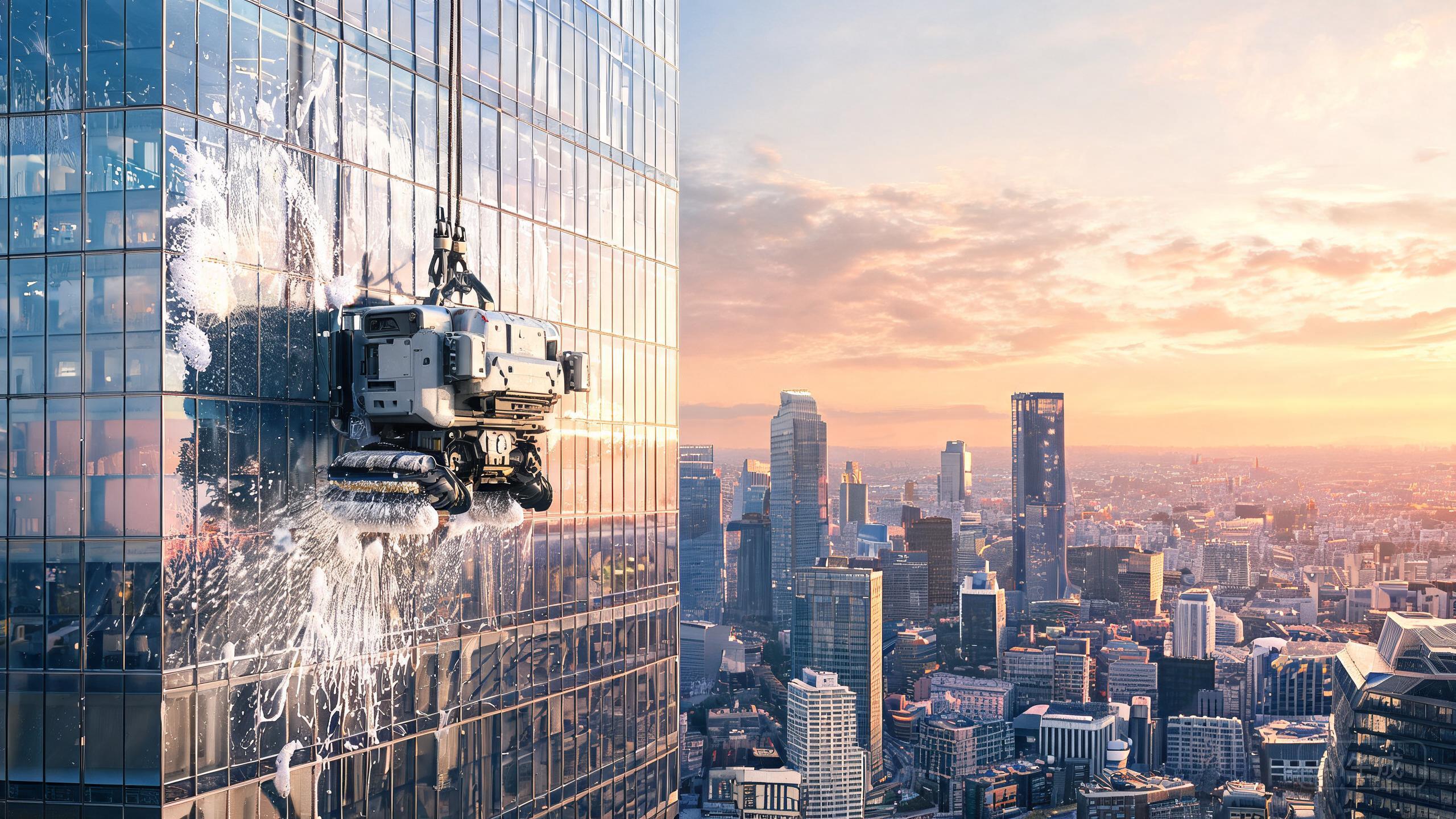
X-Human has positioned the LingKong K3 as a curtain-wall specialist rather than a general-purpose window washer. In our latest building facade cleaning robot review, the K3 earns an 8.2 rating for targeting skyscrapers directly, integrating adhesion and cleaning modules, and climbing tall continuous facades. As high rise facade cleaning automation accelerates in 2026, the K3 stands out as one of several Chinese entrants pushing robots into supertall maintenance — a segment where rope access crews still dominate but where the economics are shifting fast.
Why Curtain Walls Are the Hardest Test for Any Facade Robot
Curtain-wall facades are continuous, glass-heavy, and often rise hundreds of meters without a break. That combination defeats many suction-based cleaners, which lose grip on smooth panels or struggle with vertical runs. The LingKong K3 is designed around this exact challenge: its target is curtain-wall facades, its locomotion is climbing, and its cleaning is handled by integrated modules. For building owners evaluating a glass facade cleaning robot cost model, the appeal is a single platform that handles tall, uninterrupted glass without scaffolding or suspended platforms. The trade-off is that public specs remain sparse, and the K3 has limited international track record outside China.
Robotic Facade Cleaning vs Rope Access: Where the K3 Fits
The core argument for robotic facade cleaning vs rope access is not just safety — it is repeatability. Rope crews are flexible but weather-dependent, labor-intensive, and hard to schedule on supertall buildings. A climbing robot like the K3 can, in principle, run continuous cleaning cycles on a skyscraper facade with less human exposure at height. X-Human's integrated-module approach also reduces the number of separate tools on the wall. That said, the K3 is not a universal replacement: rope access still wins on complex geometries, repairs, and irregular facades. The realistic 2026 picture is hybrid — robots for routine glass runs, humans for the exceptions.
How the K3 Compares in the 2026 Robot Ranking Landscape
In any 幕墙清洁机器人排名 2026, the LingKong K3 occupies a specific niche: supertall curtain walls. It is not competing with compact residential glass cleaners such as the Ozmo window cleaning robot, which targets indoor panes and small exterior windows. The K3 competes with other Chinese climbing platforms aimed at commercial facades. Its strengths — curtain-wall focus, supertall capability, integrated cleaning modules — map directly to high rise facade cleaning automation budgets. Its weaknesses — sparse public specs and limited overseas deployments — are typical of a young platform still proving itself. An 8.2 rating reflects a promising specialist, not a finished global standard.
What Buyers Should Watch Before Choosing the LingKong K3
For facility managers weighing a building facade cleaning robot review, the K3 raises three practical questions. First, cost: a glass facade cleaning robot cost depends heavily on building height, facade area, and how often cleaning is required — the K3's value case strengthens with taller, more continuous glass. Second, integration: the K3's climbing locomotion and integrated cleaning modules must fit existing maintenance schedules and safety protocols. Third, support: with limited international track record, buyers should confirm service coverage before committing. The K3 is a credible 2026 facade cleaning robot for supertall curtain walls, but it rewards due diligence.
Our verdict
The X-Human LingKong K3 is a focused bet: curtain-wall skyscrapers, climbing locomotion, integrated cleaning. It will not replace rope access everywhere, and its sparse public specs and limited international track record temper the 8.2 rating. But as high rise facade cleaning automation matures in 2026, the K3 shows where the market is heading — specialized robots for the tallest, most repetitive glass surfaces.