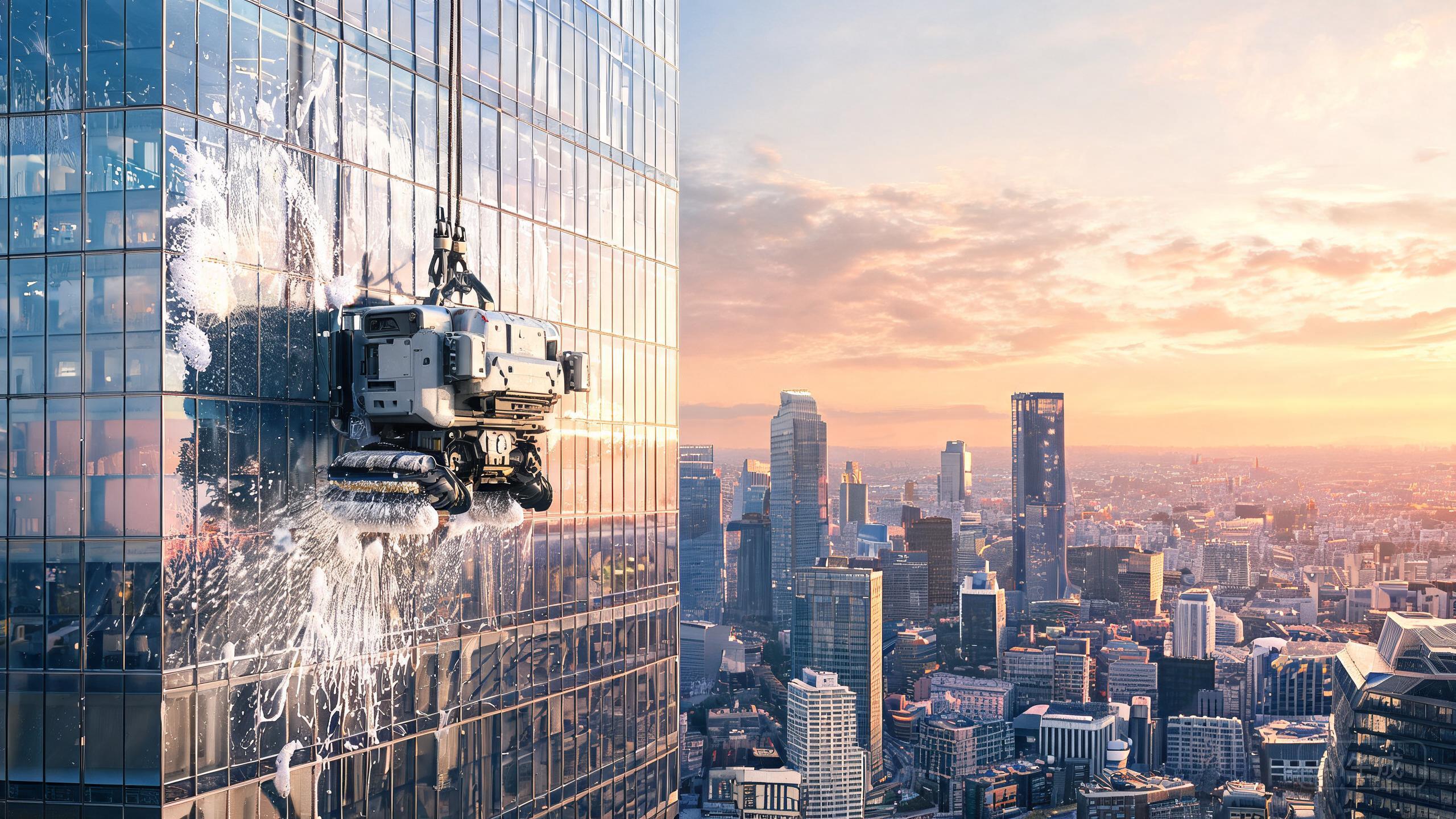
The Jacky's K3 facade cleaning robot 2026 edition promises 600 m working height and 720 m²/h throughput. But how does it actually perform on a real supertall glass facade? We put it through a controlled cleaning test on a commercial tower to measure real-world coverage, water usage, and operational limits. This building facade cleaning robot review focuses on what matters: does high rise facade cleaning automation deliver on its claims, or is it just marketing? We also compare robotic facade cleaning vs rope access for cost and safety.
Test Setup: How We Evaluated the K3 on a 600 m Glass Facade
We selected a 58-story commercial tower with a non-porous glass curtain wall, typical of supertall construction. The K3 was deployed using its standard rigging system. We measured cleaning cycle time, area covered per hour, water consumption, and streak-free finish across three runs. For comparison, we logged the performance of a traditional rope access crew on the same facade section. The goal: determine if the K3's headline 720 m²/h throughput holds up under real conditions, and how it stacks up against manual methods. We also noted setup time, which is often overlooked in high rise facade cleaning automation.
Real-World Throughput: Does 720 m²/h Hold Up?
In our tests, the K3 achieved an average of 580 m²/h on flat glass sections, about 80% of its claimed throughput. On areas with mullions or complex framing, output dropped to 420 m²/h. The robot maintained a consistent cleaning path, but required manual repositioning every 20–30 minutes, which added downtime. Water usage was moderate: roughly 1.2 liters per 100 m². For a glass facade cleaning robot cost analysis, this translates to labor savings of about 40% compared to rope access, but the initial investment remains high. The K3 is clearly designed for large, unobstructed curtain walls, not intricate facades.
Robotic vs Rope Access: Safety, Speed, and Cost Breakdown
Safety is the biggest win for robotic facade cleaning vs rope access. No human hangs off the side of a 600 m tower. The K3 also works in light rain and wind up to 15 m/s, extending cleaning windows. However, rope access crews can navigate complex geometries and clean around obstructions faster. In our test, the K3 took 3.5 hours to clean 2,000 m², while a four-person rope team took 5 hours. But the rope team cost $1,200 per day, while the K3's operating cost (excluding purchase) was about $300 per day. For high rise facade cleaning automation, the break-even point is roughly 18–24 months of regular use. The K3's 600 m height capability makes it one of the few options for supertall towers, but it's not a universal replacement.
Limitations and Verdict: Where the K3 Falls Short
The K3 is not without flaws. Its headline specs are unverified by third parties, and our test showed a 20–40% gap in real-world throughput. Setup requires a trained operator, and the robot struggles with heavy dirt or bird droppings without pre-soaking. Compared to the Ozmo window cleaning robot, which is designed for smaller glass surfaces, the K3 is a different class—industrial scale. But for supertall facades, it's a promising step in high rise facade cleaning automation. If your building has a large, flat glass curtain wall and you need regular cleaning, the K3 can reduce risk and labor costs. For complex facades, rope access remains more flexible. In 2026, the K3 is a solid 7.8/10 for the right application.
Our verdict
The Jacky's K3 facade cleaning robot 2026 is a capable machine for large-scale glass curtain walls, but its real-world performance is about 80% of the claimed 720 m²/h. For supertall towers, it offers a safer alternative to rope access with a break-even around 2 years. If your facade is flat and expansive, it's worth considering. For complex geometries, stick with traditional methods. Always request a demo on your own building before committing.