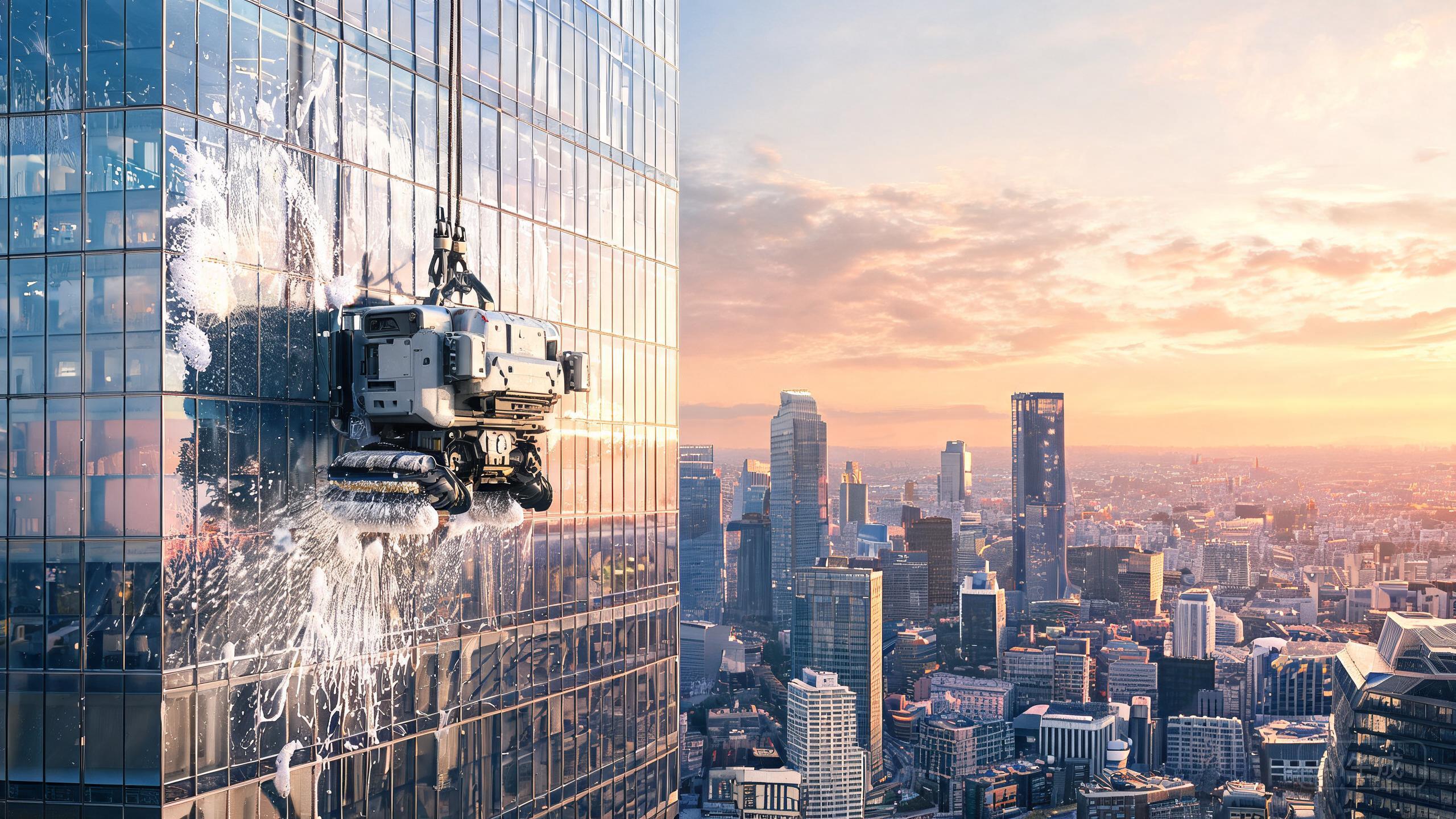
Most coverage of the Jacky's K3 focuses on its headline numbers — 600 m working height and 720 m²/h throughput. This analysis takes a different angle: the money. If you are weighing a building facade cleaning robot review for procurement in 2026, the real question is not whether the K3 is fast, but whether its price band, operating model and payback period justify choosing robotic facade cleaning vs rope access. Below is a cost and value-for-money breakdown based on the published product data, with realistic budget categories you can use in an RFP.
What You Are Actually Paying For: The Spec-to-Cost Logic
The K3's value proposition rests on two figures: 600 m working height and 720 m²/h throughput, targeting supertall facades and large commercial towers. In pricing terms, those two numbers drive cost in opposite directions. The 600 m height class places the K3 in the supertall segment, where rope access teams need extensive rigging, certifications and insurance — so the robot's addressable savings pool is largest on exactly these buildings. The 720 m²/h throughput, meanwhile, is what determines how quickly the unit amortizes: at that rate, a single machine can theoretically cover very large glass areas per shift, which is the core of the high rise facade cleaning automation business case. Because the headline specs remain unverified by independent testing, treat any vendor ROI model as a scenario, not a guarantee — and ask for a paid trial on one elevation before committing.
Cost Structure: Where the Budget Lines Actually Go
A glass facade cleaning robot cost is never just the purchase price. For a supertall-class machine like the K3, procurement budgets typically break into five lines. First, capital cost: the unit itself, plus any building-specific docking, rail or suspension interface. Second, installation and commissioning: supertall deployments involve engineering surveys, anchor points and safety sign-off. Third, consumables and maintenance: brushes, seals, water filtration and periodic service. Fourth, operator cost: even highly automated systems need trained supervisors, and the K3's industrial pace implies a two-person crew on some sites. Fifth, insurance and compliance: robotics on occupied towers often require additional coverage and method statements. When comparing against rope access, model all five lines — rope teams look expensive per job but carry near-zero capital outlay, so the crossover point depends on cleaning frequency. Towers washed four or more times a year favor automation; once-a-year buildings rarely do.
Value-for-Money Scenarios: Who Gets a Payback, Who Does Not
Run three scenarios. Scenario A — a 300 m+ glass tower washed quarterly: the K3's 600 m height ceiling and 720 m²/h rate are fully utilized, and robotic facade cleaning vs rope access savings compound across four cycles a year. This is the profile where payback is most plausible. Scenario B — a mid-rise commercial block under 100 m washed twice a year: the K3 is dramatically over-specified; a smaller, cheaper facade cleaning robot 2026 model — or even a compact device in the Ozmo window cleaning robot class for interior and low-exterior glass — delivers better value per dollar. Scenario C — a portfolio operator running several supertall towers: the K3's economics improve further because one unit and one trained crew can rotate across sites, spreading capital cost. The pattern is consistent: the K3 rewards scale and frequency, and punishes occasional, low-altitude use. Because its headline specs are unverified and its claims are broad, insist on measured throughput data from a reference site before you sign.
Negotiating the Deal: Five Questions That Protect Your Budget
Before signing, ask five cost-focused questions. One: what is the delivered price including docking or suspension interfaces specific to my facade? Two: what is the guaranteed throughput on my glass type, in writing, and what happens if it is not met? Three: what is the annual consumables and service cost, and is there a service-level agreement? Four: how many operators are required per shift, and what training is included? Five: what is the residual value or lease-to-own option if the automation program is scaled back? These questions convert a broad marketing claim into a defensible total-cost-of-ownership model, and they give you leverage in a category where published specifications still outrun independent verification.
Our verdict
The Jacky's K3 is priced and positioned for the top of the market: 600 m of working height and 720 m²/h of throughput aimed at supertall curtain walls and large commercial towers. On that profile, and at high cleaning frequency, the value-for-money case for high rise facade cleaning automation is credible. On shorter buildings or low-frequency schedules, the same budget buys better-fit alternatives. Judge the K3 not by its headline numbers but by your building's height, glass area and annual wash count — those three variables decide whether it pays for itself.