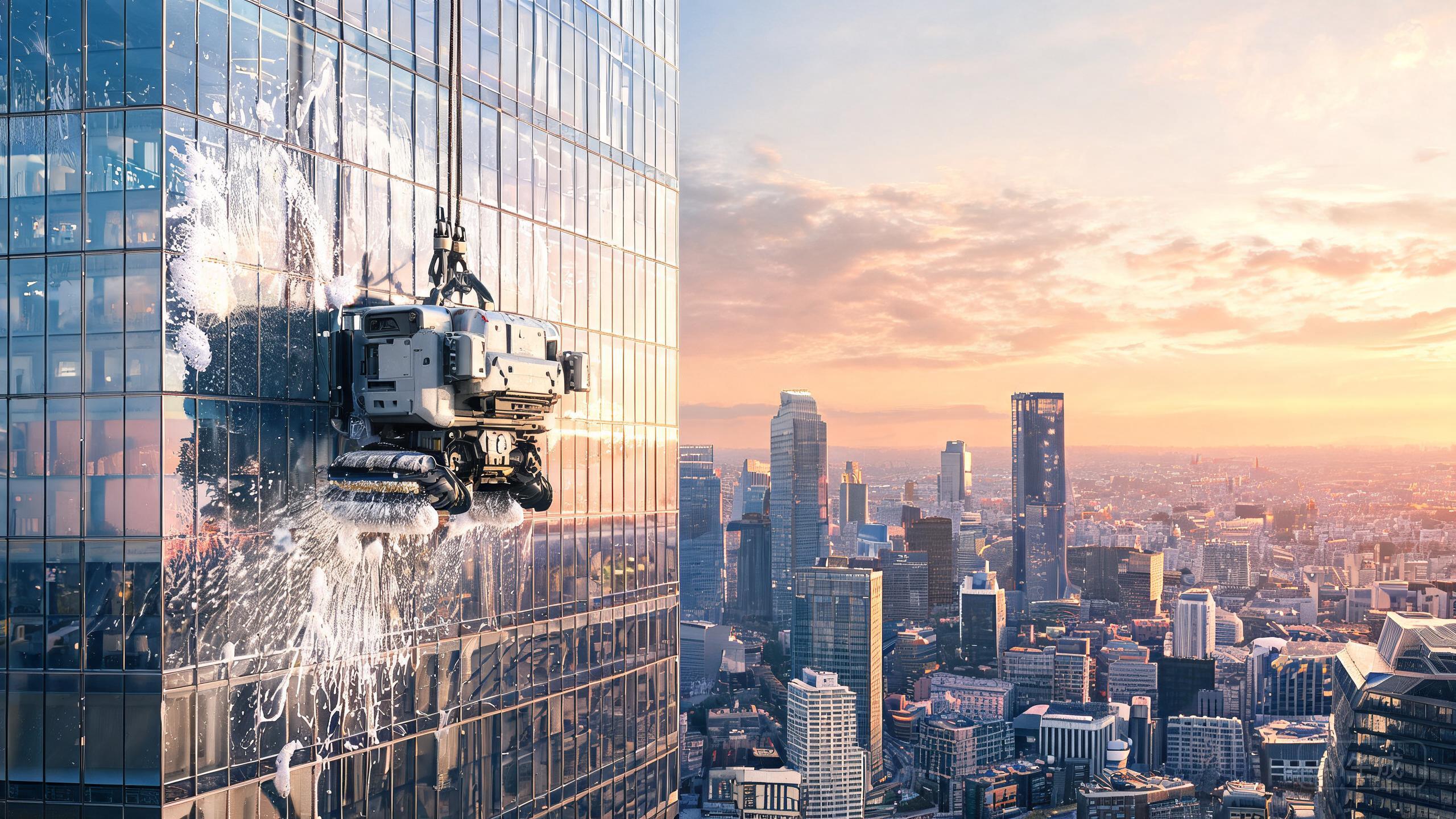
If your building rises past 300 meters, facade maintenance stops being a routine chore and becomes a logistics problem. The Jacky's K3 enters that conversation with two headline numbers: a 600 m working height and 720 m²/h throughput. This guide looks at who should actually consider it in 2026, how it compares with rope access, and what to verify before signing a purchase order.
What the K3 Actually Claims — and Why the Numbers Matter
The K3's spec sheet is short and pointed: 600 m working height, 720 m²/h throughput, target use case supertall facades on large commercial towers. For a building facade cleaning robot review in 2026, those figures are the whole story. A 600 m reach puts the K3 in range of most supertall curtain walls, while 720 m²/h suggests a single unit could cover a meaningful share of a tower's glass surface in one shift. The catch is that both figures are headline claims, not independently verified results. Treat them as design targets and ask for site-specific test data before you commit.
Robotic Facade Cleaning vs Rope Access: The Real Trade-Offs
Rope access crews are flexible, proven, and can reach awkward geometry, but they are slow, weather-sensitive, and carry safety and insurance overhead. High rise facade cleaning automation changes the equation: a machine like the K3 can work longer shifts, repeat the same path consistently, and reduce the number of people suspended on the wall. The trade-off is upfront cost, setup time, and dependence on a facade that suits the robot's anchoring or movement method. For a smooth, repetitive glass curtain wall on a supertall tower, the automation case is strong. For complex, irregular facades, rope access may still win.
Glass Facade Cleaning Robot Cost: What Buyers Should Budget For
Published pricing for supertall-capable facade robots is rare, and the K3 is no exception. When budgeting, look beyond the sticker price. Factor in delivery and rigging, operator training, spare parts, cleaning consumables, and a service contract. Compare that total against your current annual rope-access spend, including safety compliance and downtime. A 720 m²/h throughput claim only pays off if the machine actually runs at that rate on your facade, so build a pilot trial into the contract. If the numbers hold up, the payback window on a supertall tower can be attractive; if they do not, the K3 becomes an expensive experiment.
Where the K3 Fits in a 2026 Procurement Shortlist
In the broader 幕墙清洁机器人排名 2026 landscape, the K3 sits in the supertall niche rather than the general-purpose tier. It is not a competitor to compact units like the Ozmo window cleaning robot, which targets interior or smaller exterior glass. The K3 is aimed at owners and facility teams running large commercial towers with extensive curtain walls. Before shortlisting it, confirm three things: the facade type and geometry, the actual measured throughput on a test section, and the local service network. If those check out, the K3 deserves a serious pilot. If not, keep it on the watchlist and revisit when verified data appears.
Our verdict
The Jacky's K3 is a focused bet on supertall facade maintenance. Its 600 m height and 720 m²/h throughput are exactly the numbers a large commercial tower needs, but they remain unverified headline claims. Buy it only after a paid pilot on your own facade, and compare the full cost against rope access. For the right building, the K3 could be a genuine step change in high rise facade cleaning automation. For the wrong one, it is an expensive conversation piece.