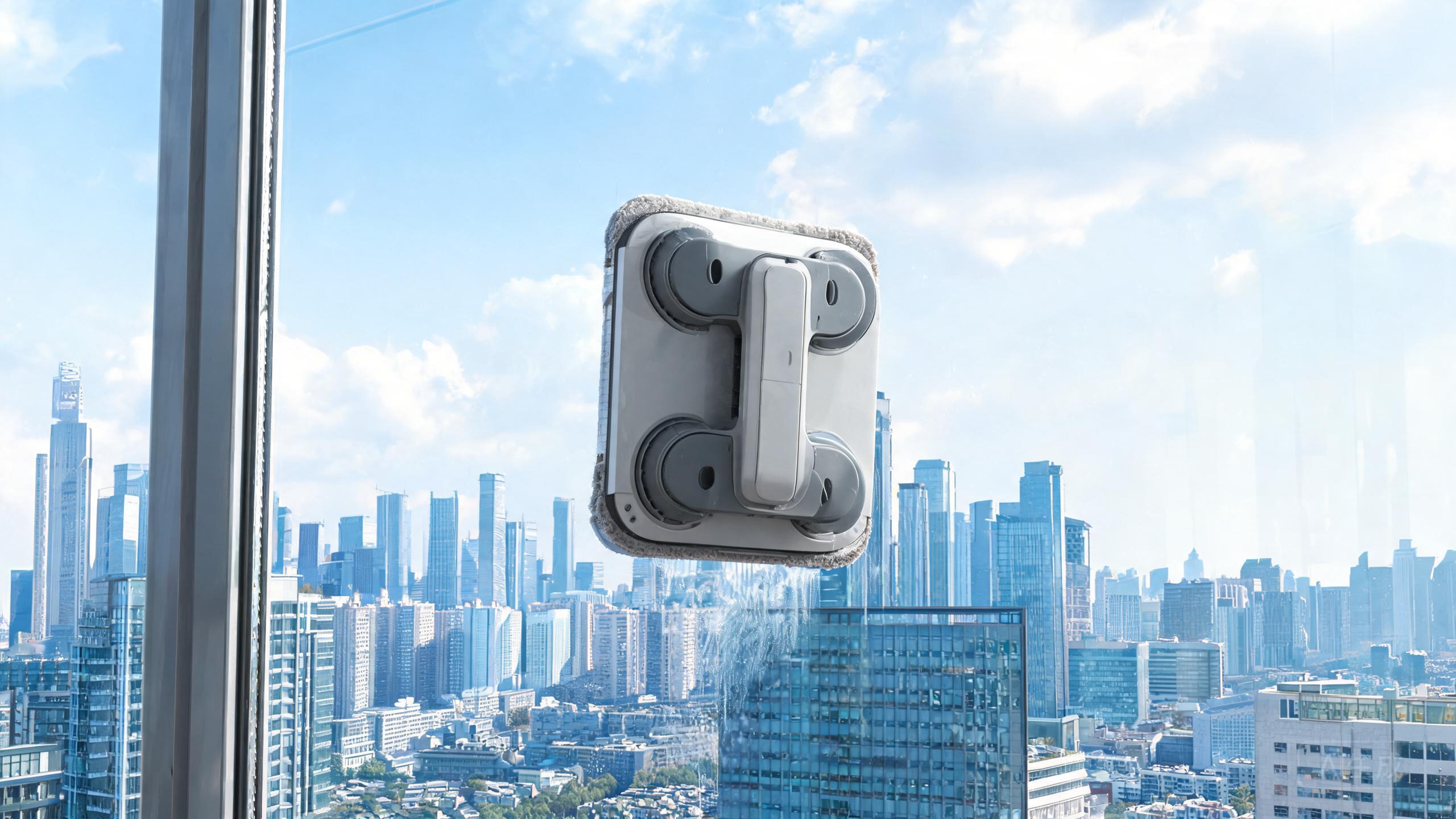
Most coverage of the HOBOT 298 focuses on whether it beats its predecessor. This deep dive takes a different angle: we break down the hardware and firmware story behind the spec sheet. If you are searching for the best window cleaning robot 2026 for tall glass, the details below explain what 'upgraded navigation' and 'enhanced safety' actually mean in daily use, and how the corded power design shapes the experience.
Navigation System: What 'Upgraded' Means on Glass
The HOBOT 298 lists its navigation as 'Upgraded' — a meaningful step for a robot window cleaner review, because navigation on vertical glass is fundamentally harder than on a floor. There are no walls to bump into for orientation, no carpet texture to read, and reflections can confuse naive sensors. An upgraded navigation stack typically improves path planning and edge detection, so the unit covers more glass per pass and spends less time re-cleaning the same pane. For high-rise windows, that efficiency matters: fewer passes means less time hanging on the outside of a building. This is a core reason the 298 earns its 'High-rise ready' label in the best window cleaning robot 2026 conversation.
Safety Architecture: Enhanced Protection for High-Rise Glass
'Enhanced' safety is the headline spec, and it is the one that matters most when you are looking for the best robot for high rise windows. The 298 is explicitly tuned for high-rise use, which means its safety systems are designed around the worst-case scenario: a loss of adhesion at height. Window cleaning robot safety in this class depends on multiple layers — suction retention, edge awareness, and a tether or backup system. The 298's enhanced safety rating indicates these layers have been strengthened relative to the 268. The tagline 'High-rise window specialist' is not marketing fluff; it reflects a design priority where safety margins are wider and the robot is expected to operate where a fall is unacceptable.
Suction and Corded Power: The Physics Behind the Grip
Window cleaner suction power is the single physical force keeping the robot on the glass, and it is inseparable from the power design. The HOBOT 298 is corded — listed as a con for portability, but a deliberate engineering choice. A corded supply delivers continuous, stable voltage, which supports sustained suction without the sag that battery-powered units can experience as charge drops. For high-rise work, consistent suction is safer than peak suction, because the robot must hold on for the entire cleaning cycle, not just at the start. The trade-off is the cable itself, which must be managed during operation. If you are weighing whether an automatic window washer worth it for tall glass, the corded design is arguably a safety feature rather than a limitation.
Positioning vs the 268: A Spec-Level Comparison
The 298's spec sheet reads as a focused upgrade rather than a redesign. Navigation moves to 'Upgraded', safety moves to 'Enhanced', and the target environment is explicitly 'High-rise'. The 268 remains a capable cleaner, but the 298 concentrates its improvements where height makes them count. The cost is a higher price than the 268, plus the corded constraint both models share. For buyers comparing the two, the question is not which cleans better in absolute terms, but whether your windows are tall enough that upgraded navigation and enhanced safety change the risk equation. For single-story or easily reachable glass, the 268 may be sufficient. For anything above ground level, the 298's spec emphasis is the more rational choice.
Our verdict
The HOBOT 298 is not a spec-sheet maximalist; it is a targeted tool for vertical, high-altitude glass. Upgraded navigation reduces time on the pane, enhanced safety widens the margin for error, and corded power keeps suction stable throughout the cycle. If your priority is the best window cleaning robot 2026 for high-rise windows, the 298's technical profile is coherent and purpose-built. If your glass is low and easily reached, the 268 remains the more economical path.