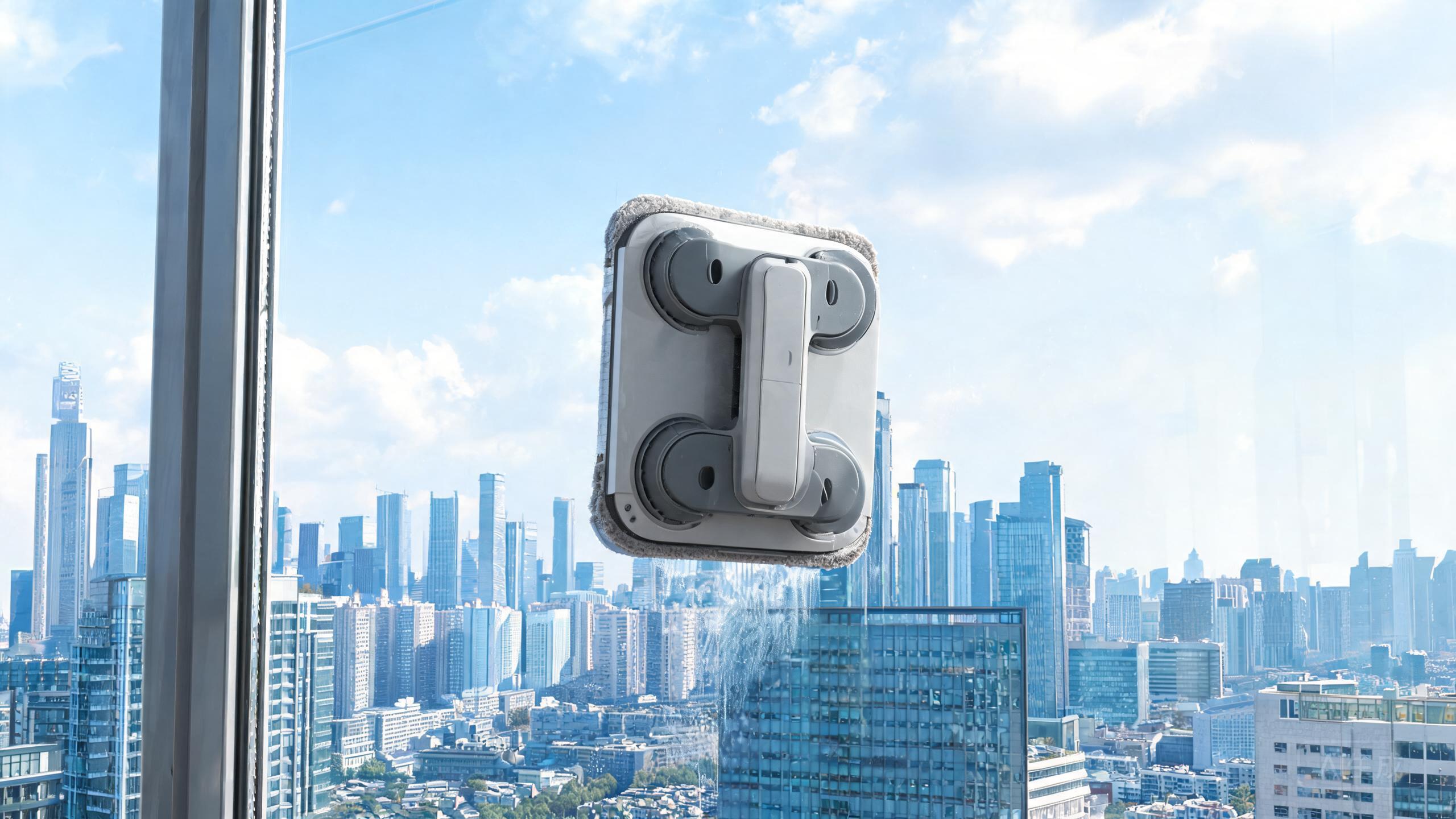
Most coverage of the Mamibot iGLASSBOT W100 focuses on price or setup. This deep dive looks at the hardware itself: how its vacuum adhesion works, what corded power means in practice, and why its compact body defines both its strengths and its limits. If you are weighing whether an automatic window washer worth it for small panes, the specifications tell the story better than the marketing does.
Vacuum Adhesion: How the W100 Stays on Glass
The W100 relies on vacuum adhesion, the same fundamental mechanism used across the category. A pump draws air from beneath the chassis to create negative pressure against the pane, holding the unit in place while it moves. In this entry-level design, the practical takeaway is that window cleaner suction power is tuned for smaller surfaces rather than large expanses of glass. That is consistent with the stated cons: weak on large windows. For anyone researching window cleaning robot safety, the key point is that adhesion is the primary safety system here, so the machine should only be run on smooth, intact glass within its intended size range.
Corded Power: What It Means for Runtime and Placement
The specification sheet lists power as corded, which shapes daily use more than any single number. There is no battery to recharge or degrade, so runtime is effectively continuous as long as the unit stays plugged in. The trade-off is a tether: the cable limits how far the robot can travel and must be managed so it does not snag or pull. For small panes near an outlet, this is a minor inconvenience. For anyone hunting the best robot for high rise windows, a corded design also means the power lead becomes part of your safety planning, and the W100's modest performance on large glass makes it a poor match for big high-rise facades regardless of adhesion.
Compact Size: Storage, Handling and Coverage Trade-offs
Size is listed simply as compact, and that single word explains most of the user experience. A small chassis is light, easy to lift onto a pane, and simple to store between uses, which matches the listed pros of compact and light plus easy to handle. The same dimensions cap coverage: a smaller body means more passes to finish a given area, and the minimal feature set means little automation to compensate. In a robot window cleaner review, this is the classic entry-level profile: hardware that is genuinely convenient for small jobs and honestly limited beyond them.
Where the Specs Fit in 2026: Price Tier and Expectations
Every listed spec points the same direction: entry-level price tier, compact size, corded power, vacuum adhesion. There is no premium sensing array or advanced navigation in the data, which is why the overall rating sits at 6.8. Judged against the best window cleaning robot 2026 contenders, the W100 is not a performance leader, and it does not pretend to be. Judged as a low-cost tool for small panes, the specifications are coherent and the low price is reflected in modest output. Whether an automatic window washer worth it depends on your glass: small, smooth, outlet-adjacent panes are its home turf.
Our verdict
Read as a spec sheet rather than a sales pitch, the Mamibot iGLASSBOT W100 is internally consistent: vacuum adhesion, corded power and a compact body add up to a light, affordable tool for small panes, with performance limits that match the entry-level price tier. Buy it for what the specifications describe, not for what a flagship window robot does.