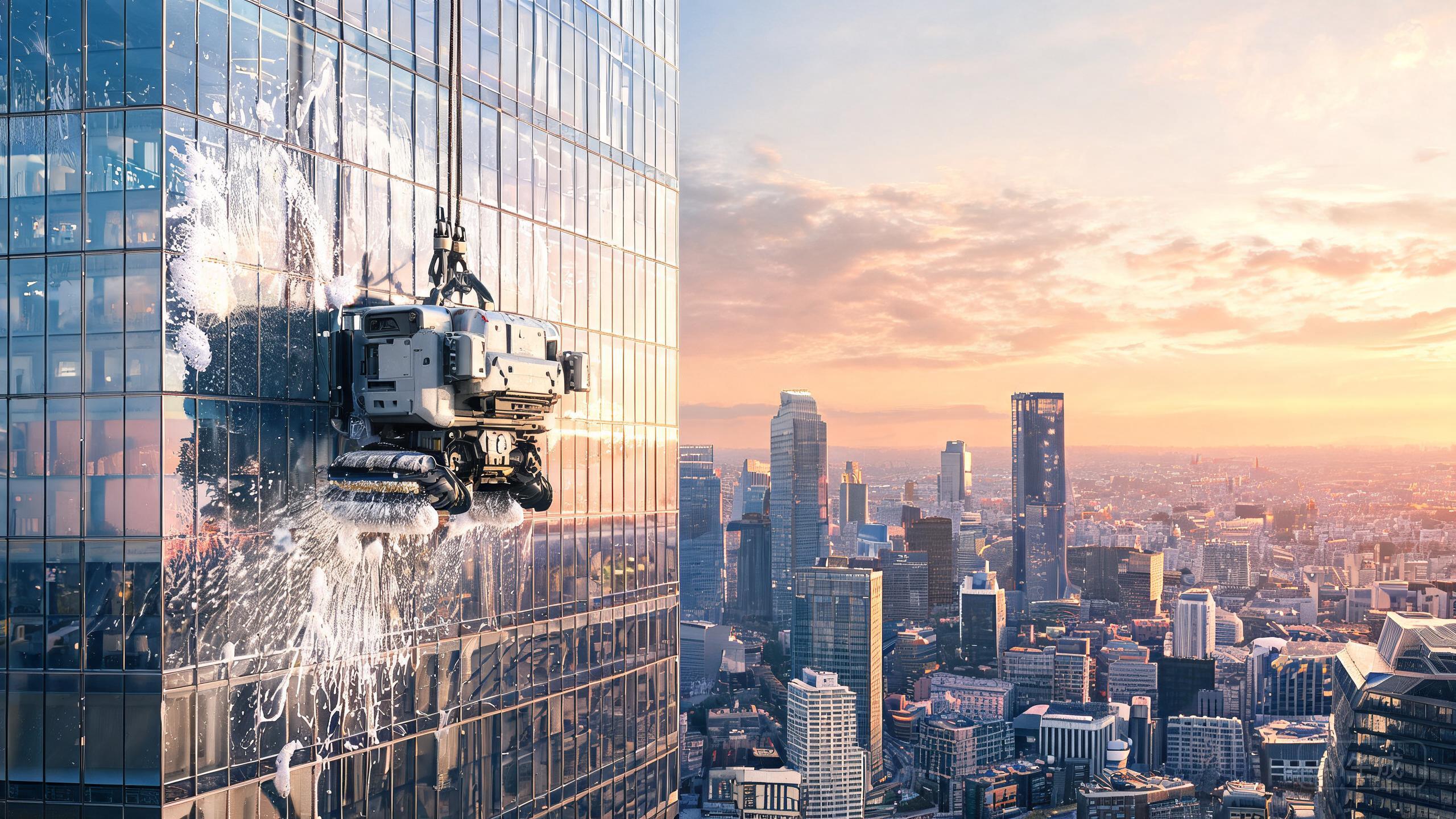
The Fraunhofer SIRIUS is not your average facade cleaning robot. Developed by Fraunhofer IFF, this rail-free research system represents a bold step toward high rise facade cleaning automation. While it is not a commercial product, its wall-climbing locomotion and proof-of-concept design offer a glimpse into the future of building maintenance. In this 2026 update, we examine how SIRIUS influences the next generation of glass facade cleaning robots and why it matters for the industry.
Why Rail-Free Movement Changes the Game
Most facade cleaning robots rely on fixed rails or ropes, which limits their flexibility and increases setup time. SIRIUS, however, moves without guides, using a wall-climbing locomotion system that adheres directly to surfaces. This rail-free approach is a cornerstone of high rise facade cleaning automation. By eliminating rails, SIRIUS demonstrates that robots can navigate complex building geometries more freely. For the building facade cleaning robot review community, this is a significant milestone. It suggests that future robots could operate on diverse facades without costly infrastructure. While SIRIUS is still a research system, its design philosophy challenges the status quo and inspires commercial developers. As we look toward 2026, the facade cleaning robot 2026 landscape will likely see more rail-free concepts, and SIRIUS is a key precursor.
Research Pedigree and Real-World Limitations
Fraunhofer IFF is renowned for applied research, and SIRIUS benefits from this pedigree. Its pros include rail-free movement and proof-of-concept pioneering. However, it is not a commercial product, and its real-world duty is limited. This means it is not yet ready for daily cleaning tasks on skyscrapers. But that is precisely why it is valuable: it tests the boundaries of what is possible. In the context of robotic facade cleaning vs rope access, SIRIUS highlights the potential for robots to replace dangerous rope access work. Rope access is risky and slow, while a robot like SIRIUS could one day operate autonomously. For now, SIRIUS remains a demonstrator, but its lessons inform the development of commercial systems. The glass facade cleaning robot cost is a major barrier to adoption, and research like SIRIUS aims to reduce costs by simplifying hardware and eliminating rails.
What SIRIUS Means for the 2026 Facade Cleaning Market
As we approach 2026, the facade cleaning robot 2026 market is poised for growth. SIRIUS, though not commercial, signals a shift toward more agile and autonomous systems. The high rise facade cleaning automation sector is increasingly interested in robots that can operate without extensive setup. SIRIUS proves that rail-free climbing is feasible, which could lead to lighter, faster, and cheaper robots. For those comparing robotic facade cleaning vs rope access, the research behind SIRIUS strengthens the case for robotics. Additionally, the glass facade cleaning robot cost is expected to decrease as technology matures, making automation accessible to more buildings. While SIRIUS itself may never be sold, its influence will be felt in future products. The building facade cleaning robot review community should watch for commercial spin-offs that adopt SIRIUS's rail-free approach. In the Chinese market, 幕墙清洁机器人排名 2026 will likely reflect these advancements, and 外立面清洁机器人测评 will highlight the shift toward automation.
The Road Ahead: From Research to Commercialization
SIRIUS is a research system, but its legacy could be profound. The next step is for commercial partners to license or build upon its rail-free technology. This would require addressing durability, speed, and cost. The glass facade cleaning robot cost must come down to compete with traditional methods. However, the potential is enormous: high rise facade cleaning automation could become standard, reducing accidents and improving efficiency. For now, SIRIUS stands as a testament to innovation. It reminds us that today's research is tomorrow's product. As we track the facade cleaning robot 2026 trends, SIRIUS will be remembered as a pioneer. Whether you are a facility manager or a tech enthusiast, keeping an eye on Fraunhofer IFF's work is wise. The Ozmo window cleaning robot, for instance, is a commercial example of automation for smaller surfaces, but scaling to high rises requires breakthroughs like SIRIUS. The journey from lab to rooftop is long, but SIRIUS lights the way.
Our verdict
Fraunhofer SIRIUS may not be a commercial product, but it is a crucial piece of the high rise facade cleaning automation puzzle. Its rail-free movement and research pedigree make it a pioneer in robotic facade cleaning vs rope access. As the industry moves toward 2026, SIRIUS will continue to inspire cost-effective and safe solutions. For a comprehensive building facade cleaning robot review, SIRIUS deserves attention for its role in shaping the future. Keep an eye on how its concepts translate into commercial robots that could one day clean our skyscrapers.