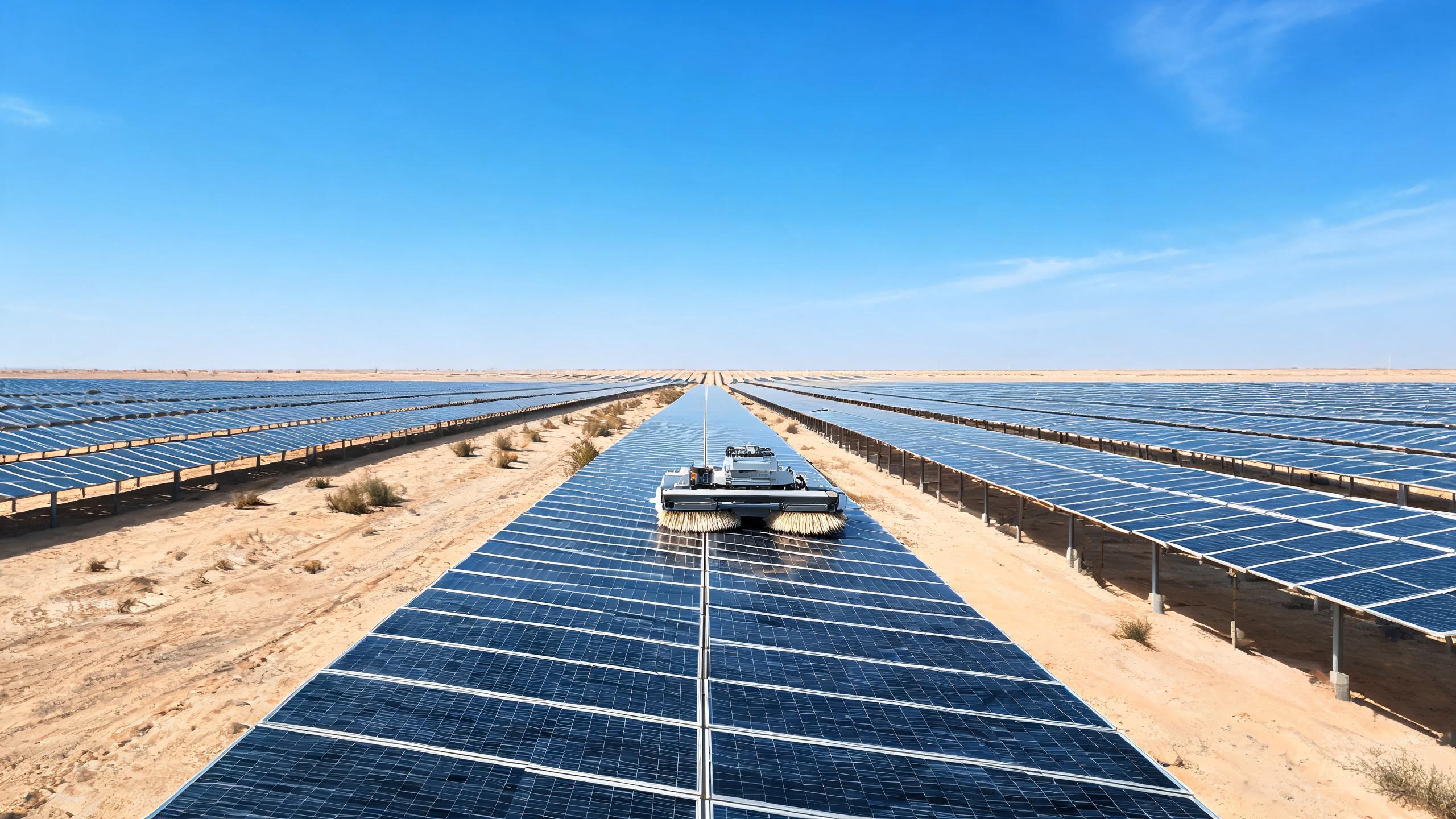
Most reviews of the Lovsun PV Cleaner Robot treat it as a finished consumer product. It is not. This is a China OEM unit distributed through Alibaba and B2B channels, and the right way to judge it is as a sourcing decision rather than a shelf purchase. If you operate a solar farm and you are weighing the best solar panel cleaning robot 2026 options against a tight budget, the Lovsun unit deserves a serious look — provided you understand what you are buying, what you are giving up, and how the numbers work. This guide focuses on procurement reality: price structure, cleaning method, and whether the savings survive contact with an actual PV site.
What the Lovsun PV Cleaner Robot Actually Is
Strip away the marketing and the Lovsun PV Cleaner Robot is a brush-based cleaning unit manufactured in China and sold primarily through Alibaba and B2B channels. The spec sheet is deliberately short: brush cleaning, OEM customization options, Chinese origin, direct sourcing. There is no glossy app ecosystem, no proprietary docking station, no regional service network. What you get instead is a configurable platform. Buyers can adjust aspects of the unit through OEM options, which matters if your array has unusual row spacing or mounting geometry. The trade-off is equally clear: limited overseas support and quality control that varies from batch to batch. For a utility scale PV cleaning robot deployment, that means you should budget for spare parts, local maintenance capability, and a slower resolution path when something fails. This is not a plug-and-play appliance; it is equipment.
Solar Panel Cleaning Robot Cost: Where the Savings Come From
The single strongest argument for this unit is entry price. Lovsun trades polish for a low upfront number, and for large arrays that math compounds quickly. If you are comparing a solar panel cleaning robot cost across vendors, the Lovsun quote will typically sit well below branded alternatives with comparable brush cleaning functionality. But total cost of ownership is where the picture gets more nuanced. Direct sourcing means you absorb shipping, customs, and import logistics. Limited overseas support means downtime is your problem, not a service contract's. Quality control variance means you should inspect and test units on arrival rather than assume consistency. The honest framing: Lovsun wins on capital expenditure and loses on operational certainty. For operators with in-house technical staff and multiple sites, that trade can be favorable. For a single small installation with no maintenance capacity, it usually is not.
Dry vs Wet Solar Panel Cleaning: Why a Waterless Solar Panel Cleaner Matters
The Lovsun unit is built around brush cleaning, which places it firmly in the dry cleaning camp. That is a meaningful advantage in water-scarce regions and desert installations, where hauling water to a utility scale PV cleaning robot fleet can cost more than the cleaning itself. A waterless solar panel cleaner avoids that logistics entirely and eliminates the risk of mineral spotting left behind by hard water. The trade-off is that dry brushing is less effective against bird droppings, pollen caked on by dew, and oily soiling near industrial sites. In those conditions, a wet pass still outperforms a dry one. The practical answer for most operators is not choosing a side but matching method to site: dry brushing for routine dust management on a frequent cycle, wet cleaning as an occasional deep treatment. Lovsun fits the first role well. If your site needs heavy wet cleaning as the primary method, this is not the right tool.
Does Solar Panel Cleaning Improve Output — and Is Lovsun the Right Vehicle?
Yes, cleaning improves output, and the effect is largest in high-dust, low-rainfall environments where soiling losses accumulate between rain events. The question for buyers is whether Lovsun is the right vehicle to capture that gain. Because the unit is simple and brush-based, it is best deployed on a frequent, shallow cleaning cycle rather than as a periodic heavy scrub. That matches how soiling actually behaves: thin layers build daily and are easy to remove; thick baked-on layers are hard for any dry brush. Operators who run this robot on a tight schedule typically see the best returns. Those who let soiling accumulate and then expect one pass to fix it will be disappointed — and that is true of nearly every dry system, not just this one. Factor in the quality control variance and limited support, and the sensible deployment is a pilot array first, measured against a control string, before scaling across the site.
Our verdict
The Lovsun PV Cleaner Robot is not trying to be the best solar panel cleaning robot 2026 in any absolute sense. It is trying to be the cheapest credible one, and on that narrow goal it largely succeeds. Buy it if you have technical staff, multiple sites, water constraints, and a willingness to manage direct sourcing. Skip it if you need vendor support, consistent batch quality, or heavy wet cleaning as your primary method. Judge it as a procurement decision, and the value proposition becomes clear.