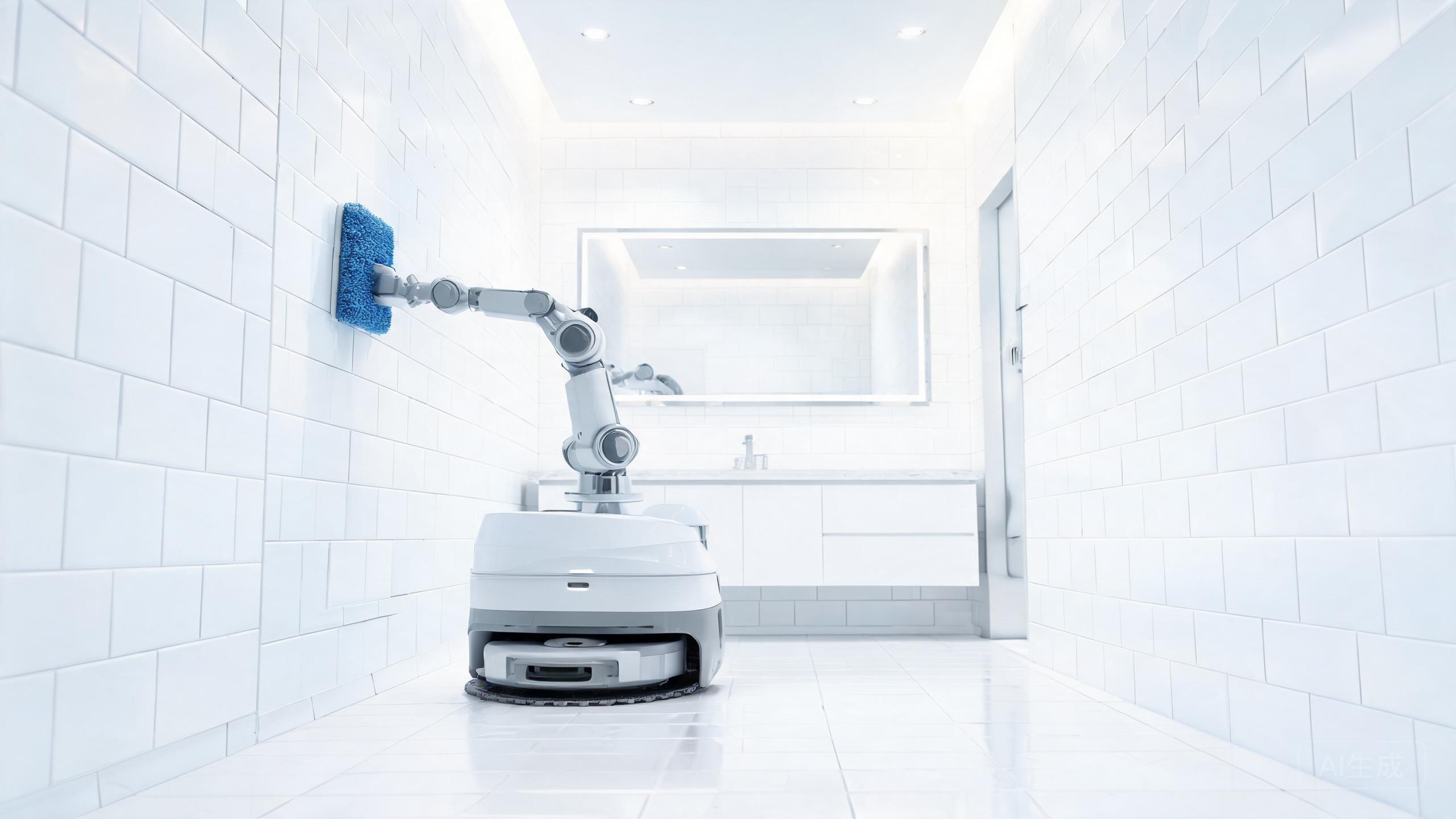
HiveBotics has been quietly positioning the Abluo Mark 2 as more than a spec-sheet upgrade. Instead of re-litigating its sensors or arm geometry, this update looks at where the robot actually fits in the 2026 buying landscape: a maturing restroom cleaning robot 2026 market, tightening labor budgets, and facility teams who need proof before they commit capital. The Abluo Mark 2 carries a 9.0 rating from our lab and a clear pitch — LiDAR-guided navigation plus a 6-DoF arm aimed at toilets and urinals — but the more interesting story is how that pitch lands against real procurement questions.
Why 2026 Is the Year Restroom Automation Gets Budget Lines
For years, restroom automation sat at the edge of facility budgets — interesting in demos, hard to justify at scale. That is shifting. The Abluo Mark 2 arrives as commercial restroom cleaning automation moves from pilot projects into line-item planning, and as operators compare the cost of unfilled cleaning shifts against a capex purchase. HiveBotics' second-generation platform targets the two fixtures that consume the most manual time: toilets and urinals. By covering both, the robot addresses the core of a restroom route rather than a peripheral task, which is exactly the argument facility managers need when they defend a purchase internally. The caveat from our review still stands: commercial ramp is ongoing, so availability and support coverage will vary by region in 2026.
The Robotic Arm Restroom Cleaner as a Labor Strategy, Not a Gadget
The most common mistake buyers make with an autonomous toilet cleaning robot is treating it as a novelty. The Abluo Mark 2 is better understood as a labor strategy. Its 6-DoF arm is designed to reach fixtures that fixed scrubbers cannot, and LiDAR navigation lets it move between stalls and urinal banks without a pre-installed guide path. That combination matters most in high-traffic commercial restrooms where cleaning windows are short and turnover is constant. In our bathroom cleaning robot review, the second-generation refinement over the earlier M1 showed up less in dramatic new features and more in reliability — fewer missed fixtures, more consistent route completion. For teams weighing headcount against automation, that reliability is the metric that decides renewal, not the demo.
Restroom Robot Cost: How to Build the Business Case
Restroom robot cost is rarely a single number, and buyers who treat it as one tend to stall. A realistic case for the Abluo Mark 2 stacks the purchase against labor hours recovered, consumable use, and the cost of inconsistent cleaning in customer-facing restrooms. Two factors from our review should shape that math. First, restroom layout dependency means sites with irregular stall geometry or tight urinal spacing may see lower effective coverage, so the payback period varies building to building. Second, because the commercial ramp is still ongoing, early adopters should factor in deployment support and training time. The strongest business cases we see are not the largest facilities, but the ones with the most predictable restroom routes — where the robot's LiDAR mapping and fixture targeting can be repeated shift after shift.
Where the Abluo Mark 2 Leaves the Category in 2026
The Abluo Mark 2 does not reinvent restroom automation, and it does not need to. Its contribution is consolidation: LiDAR navigation, a 6-DoF arm, and coverage of both toilets and urinals in a second-generation package that refines rather than expands. In the broader restroom cleaning robot 2026 field, that puts HiveBotics in the practical middle — more capable than single-fixture scrubbers, more focused than general-purpose service robots. The open questions remain the same ones our review flagged: how quickly the commercial ramp reaches new regions, and how well the system adapts to unusual restroom layouts. Buyers who answer those two questions for their own buildings will have a clearer view than any spec sheet provides.
Our verdict
The HiveBotics Abluo Mark 2 earns its 9.0 rating not by chasing headlines but by fitting into how facilities actually buy automation in 2026. If your restrooms have predictable routes and you can model restroom robot cost against recovered labor hours, it belongs on your shortlist. If your layouts are irregular or your region is still waiting for commercial coverage, plan a pilot before a purchase order.